Overview
95TIL is my independent streetwear brand. The name means "9–5 'til whenever my dreams take off," and the brand's philosophy is avoiding passionless endeavors.
The original store was a plain white catalog of about 20 products, with a dozen lookbook photos at the bottom and no story. It worked as a front end for selling, and nothing more.
I rebuilt it so the Places travel line feels like getting mail from somewhere, while buying stays as simple as any store.
My role
I led product and experience design, interaction design, ecommerce strategy, and art direction. I directed the implementation with Claude as my coding partner, then tested and iterated on real devices until it matched the intent.
What I built
Eight custom systems, all designed mobile-first.
The Rack
Shop page
A swipeable 3D clothing rack with transparent product cutouts, a size picker, and add-to-cart. Why: browsing feels like a shop, and buying stays one tap.
Sealed Packages
Product pages
On the first visit to a Places product, you peel a holographic sticker of Nine the Wolf, the flap opens, and the shirt rises into the product photo. Why: it makes a print-on-demand shirt feel collectible.
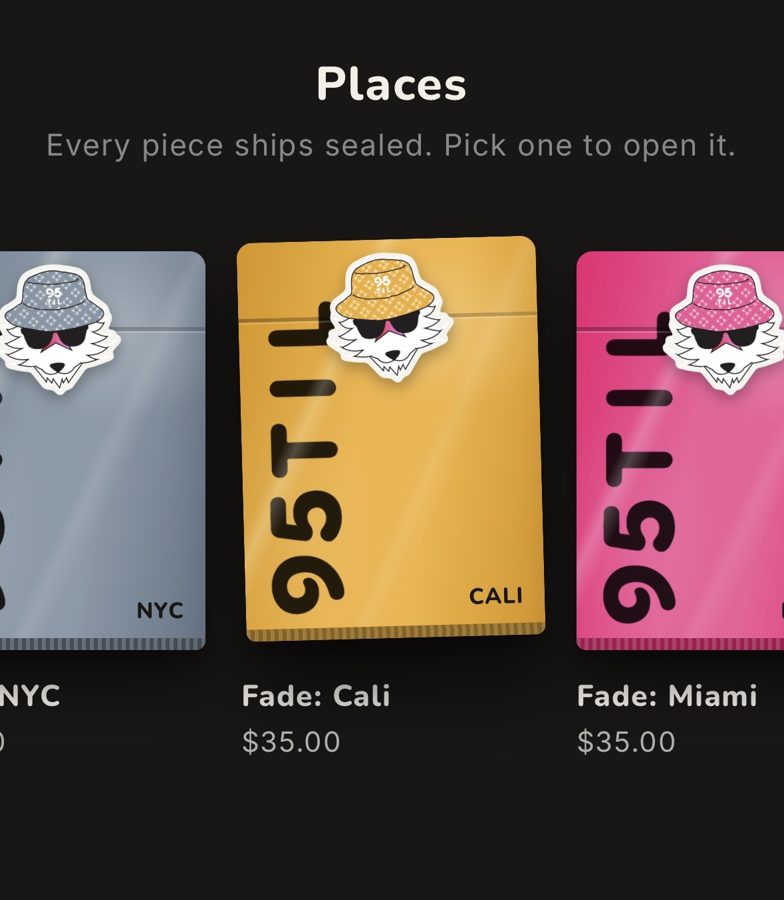
Packages Row
Shop page
The Places pieces shown as mini mailers with city seals. Why: it sets up the unboxing before the click.
City Map
Shop page
A dotted world map with city pins, route lines, local clocks, and a "Next stop?" pin with a drop countdown and email signup. Why: the travel theme becomes navigation and a reason to sign up.
Stories Row
Shop page
Full-screen vertical videos with product chips that appear at timed moments, plus a "Shop this video" sheet. Why: shoppable media that people already know how to use.
95TIL TV
Lookbook page
A CRT TV with a remote, static between channels, and an off-air test card. Why: brand personality in the editorial space.
Lookbook
Lookbook page
One photo shoot in three views: editorial chapters with shoppable dots, a Polaroid wall, and a film contact sheet that develops on scroll. Why: three moods from one shoot.
Scratch Ticket
Home page
A scratch-off ticket that reveals a launch discount with a burst of confetti. It shows once per visitor, has a tap-to-reveal fallback, and the code applies itself at checkout. Why: a playful first-purchase nudge with nothing to fill in and nothing to copy.
Key decisions
- Experimental on top, simple underneath. Every interaction ends in a standard add-to-cart.
- The unboxing plays once per product. Delight on the first visit, no friction after.
- Always a way out. A skip link after 1.5 seconds, a "Peel it for me" button, and fallbacks for reduced motion and devices without WebGL.
- No gate on the discount. The scratch ticket asks for nothing. No email wall, and the code applies itself at checkout.
- Tags and metafields, not code. The store stays manageable without a developer.
- One source of truth for cities. Colors and labels live in one shared snippet.
System design
Day-to-day merchandising happens in the Shopify admin, not in code.
| To do this | The merchant does this |
|---|---|
| Put a product on the rack | Tag it "rack" and upload a cutout to the Rack image field |
| Turn on the unboxing | Assign the "sealed" product template |
| Add a product to the map | Tag it "places" and "city-[name]" |
| Add a new city | Add two lines to the city snippet and one City block on the map |
Process
- PrototypeEach interaction started as a standalone prototype.
- ImplementI directed the Shopify build with Claude as my coding partner.
- TestPhone and desktop testing, plus headless-browser checks.
- Debug and iterateFixed theme-check issues and refined visuals until they matched the intent.
- IntegrateWired everything into the theme editor so it can be managed without code.
Result
A custom Shopify storefront, live at 95til.com since October 2026, with all eight systems running in production. It's too early for sales data, so I don't claim any.
The project shows visual craft, ecommerce UX, interaction design, systems thinking, and taking a concept all the way to a working product.
Let's talk
Designed by Kevin Kanakan, built with Claude.